Nestled off the coast of Barrow-in-Furness, Walney Island has long been a key part of the region’s history. For centuries, this picturesque island was both a source of local industry and a secluded community, separated from the mainland by the Walney Channel. Its isolation fostered a unique way of life, but also posed significant challenges for those who lived on the island, as access to and from the mainland was far from easy. Walney Island’s crossings have evolved dramatically over time.
Walney Crossings Ferries to Jubilee
1 June 2025
Before modern bridges and roads, Walney Island was connected to the mainland by a network of tidal paths, ferries, and causeways, all heavily reliant on the ebb and flow of the tides. The salt-scented sea breeze, the rhythmic lap of the waves against the shore, and the squish of wet sand underfoot were part of the daily experience for those who made the crossing. Whether it was crossing a series of stepping stones or relying on the Furness Railway Ferry, getting to and from the island required knowledge of the tides, the land, and the elements.
But as Barrow’s industrial power grew, so too did the need for a permanent, reliable connection to Walney Island. The solution came in the form of the Jubilee Bridge, a monumental project that would change the landscape of the region forever.
This is the story of how Walney Island transformed from an isolated, tide-dependent outpost into a well-connected part of Barrow-in-Furness—through a fascinating mix of ferries, tidal pathways, and the engineering marvel of the Jubilee Bridge.
We would like to extend our sincere thanks to Peter Laird, whose insightful talk, “A Walk Through Time at the Jubilee Bridge,” greatly contributed to the research and writing of this blog. His expertise and passion for the island’s history were invaluable in bringing this story to life.
Early Crossings to Walney Island
Before the construction of the Jubilee Bridge in 1908, Walney Island was effectively isolated, with limited access routes. The people of Walney Island had to rely on natural tidal crossings, ferries, and even low-tide fords to reach the mainland.
Tidal Paths and Fords Around Walney Island
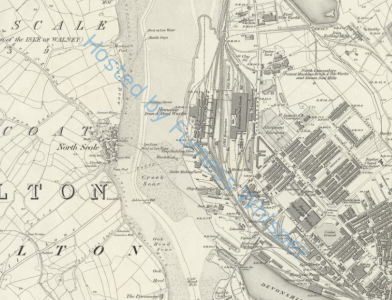
Before ferries and the Jubilee Bridge, residents of Walney Island relied on natural tidal fords to reach the mainland. These crossings, only usable at low tide, formed an essential part of everyday life for centuries. According to contemporary accounts and 19th-century maps, there were at least eight distinct fords, used until the Barrow Harbour Acts of 1848 and 1855 began reshaping the area.
Listed from north to south, here are the major fords:
Ormsgill Nook to North End Farm
Began near today’s Cocken Tunnel and headed northwest over Walney Meetings, ending at North End Farm. This was the earliest known ford, likely dating to the 13th century, used by monks accessing Walney granges.
Cocken Cross
Originated at the same mainland point as the first ford but led southwest to Lenny Hill, with a branch to Croft Brow. This was a major route for islanders before the rise of ferry services.
Middle Steps to Croft Brow
A distinct crossing from Middle Steps, again arriving at Croft Brow. This suggests Croft Brow was a frequent landing area for multiple tidal paths.
Stepping Stones (later footbridge)
This ford became a regular foot route to the Iron and Steel Works, subject to tidal conditions. It was eventually converted into a footbridge—still visible today—though often in need of repair.
Ford to North Scale Smithy
Originated from a point just above where the graving dock (now the Dock Museum) was located. It led directly to the smithy in North Scale, used regularly by tradesmen and residents.
Ashburner’s Wife Ford
Ran opposite the end of Mill Lane. Still marked on OS maps, it’s one of the better-known crossings and remains part of local oral history.
Dova Haw Ford
Crossed from Biggar over the marsh to Watergarth Nook, then over Christy Pool to Barrow Island. This complex multi-part route was used at very low tides.
Route to Piel via Sheep Island
A separate route headed from the southern end of Walney, near what became Berry’s Farm, passing close to Sheep Island and continuing onward to Piel.
When the fords were covered at high tide, residents relied on rowing ferries, which operated informally across several points along the channel.
Walney Island and the Furness Railway Ferry (1878–1908)
The Furness Railway Ferry began operating in 1878 and was a steam-powered chain ferry running from Barrow Island to Walney. This service was introduced to meet the growing needs of Barrow’s shipbuilding industry and housing developments on Walney. It carried passengers, horses, and carts across the Walney Channel until it was replaced by the Jubilee Bridge in 1908.
Why the Jubilee Bridge Was Built on Walney Island
By the late 19th century, the industrialisation of Barrow-in-Furness was well underway, with major shipyards and steelworks attracting workers from all over the region. This created a need for better transportation links, especially to Walney Island, where workers were housed in the growing town of Vickerstown.
Before the Jubilee Bridge, the only access to Walney Island was by the unreliable tidal crossings or the ferry service. As the population increased, the demand for a more permanent and consistent connection to Barrow became critical.
Building the Jubilee Bridge to Walney Island
In response to the growing need, the Jubilee Bridge was constructed. The project was proposed in 1897, during the reign of Queen Victoria, and was intended as a tribute to the Queen’s Diamond Jubilee. Construction began in 1905, with Sir William Arrol & Co. overseeing the project. The bridge was completed in 1908 at a cost of £175,000, a significant amount at the time.
The Jubilee Bridge is a bascule bridge, meaning it can lift to allow ships to pass. This was particularly important due to Barrow’s position as a major dock and shipbuilding hub. The bridge opened on 30th July 1908 and quickly became a vital link, providing both vehicular and pedestrian access between Barrow-in-Furness and Walney Island.
The construction of the bridge was a milestone for the region, marking the end of reliance on tidal crossings and ferries. The bridge was initially a toll bridge, which helped recover the construction costs. However, tolls were removed in 1935, when the bridge was renamed Jubilee Bridge in honour of King George V’s Silver Jubilee.
Walney Island’s Transport Legacy
Today, the Jubilee Bridge remains the primary means of crossing between Barrow and Walney Island, carrying thousands of vehicles daily. It’s a testament to the ingenuity of the early 20th century and a symbol of the industrial growth of Barrow.
The old tidal paths, such as Cocken Cross, Ashburner’s Wife, and the Furness Railway Ferry, are now part of local history, and only the remnants of these crossings can be seen at the lowest tides. Despite this, they hold an important place in the cultural and historical memory of Walney Island and its people.
As the bridge and its surrounding infrastructure continue to serve the community, Walney Island has become a more accessible and integrated part of Barrow-in-Furness, though the echoes of its isolated past are still present in its historic crossings.
Conclusion: Walney Island’s Journey of Connection
The history of Walney Island’s crossings—from natural tidal paths and ferries to the iconic Jubilee Bridge—illustrates the island’s transformation from an isolated community to a well-connected part of Barrow-in-Furness. The Jubilee Bridge represents not only a significant engineering achievement but also a vital turning point in the region’s development. While the old tidal crossings are no longer in use, they remain an important part of the island’s rich history, and their stories continue to shape the identity of Walney Island today.
We would like to extend our sincere thanks once again to Peter Laird, whose insightful talk, “A Walk Through Time at the Jubilee Bridge,” was instrumental in the creation of this blog. His passion for and knowledge of Walney Island’s history have been invaluable. To explore more of the fascinating history of Walney Island, we encourage you to purchase Peter’s book, Walney Island – A History, available on Amazon. If you would like a signed copy, please email us at info@furness-whisper.uk.
100%