Nestled in the tranquil and picturesque grounds of Furness Abbey, the Abbey Mill Cafe (formerly known as the Custodian’s Cottage) is not just a café, but a building steeped in centuries of history. From its medieval origins to the tragic fire and eventual transformation into the charming café it is today, this site has experienced centuries of change. Today, it offers visitors a unique blend of history, natural beauty, and warm hospitality. Let’s explore the complete history of Abbey Mill Cafe, bringing its story to life through the rich character and features that make it such a special place to visit.
Discovering the Abbey Mill Cafe: A Journey Through History and Hospitality
18 May 2025
Medieval Use: Corn Mill or Lay Steward’s Hall?
During the Abbey’s prime, the building now known as the Abbey Mill Cafe may have served an important role within the monastery’s wider estate. While its exact original purpose remains uncertain, there are two leading theories. One suggests it was a corn mill, used to grind grain for the Abbey — a vital part of monastic life and economy, as self-sufficiency was central to how abbeys operated.
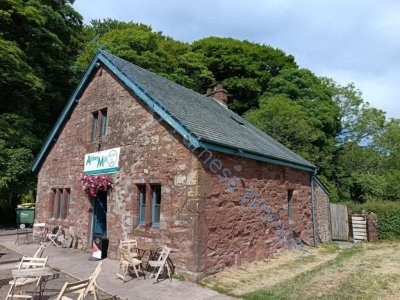
The second theory — and the one more recently favoured — is that it may have been the Lay Steward’s Hall. The Lay Steward was a senior figure in the monastery’s administration, responsible for overseeing the Abbey’s finances, land, and secular affairs. This would have made the building a key site of organisation and record-keeping.
Evidence supporting this includes remains of door frames at upper floor level, indicating that the building was once much larger, possibly extending to the front and rear. Features buried by centuries of earth suggest it could have been three times the size it is today, forming a large rectangular complex. Window and door frames, now partially below ground level, also hint at the original scale and function of the structure when Furness Abbey was fully active.
Parts of the Building Date Back to the Medieval Period
The Abbey Mill Cafe retains much of its original medieval stonework, making it one of the rare surviving ancillary buildings connected to Furness Abbey. Though time and nature have reshaped it, the building still carries the solid presence of the 12th century — its weathered walls and deep-set doorways offering a quiet glimpse into the distant past.
Standing in the café today, you can feel the cool, ancient stone beneath your feet, worn smooth from centuries of use. The air inside feels chilly and still, as if holding the secrets of the past. The weathered beams above, aged with time, create a sense of reverence and nostalgia, inviting you to step back into a time when this space played a significant role in the Abbey’s daily life.
The Custodian’s Cottage: A Shift in Purpose
As the centuries passed, the building’s purpose evolved with the advent of tourism. In the 1800s, it became known as the Custodian’s Cottage, home to the individual responsible for maintaining the Abbey ruins. This transformation into a base for care and tourism allowed the building to remain connected to the Abbey’s history, even as its function changed.
You can almost imagine the footsteps of custodians walking the stone-paved path, their hands roughened by work but gentle as they cared for the grounds. The scent of damp stone, the rustling of nearby trees, and the presence of history all contribute to the quiet atmosphere still felt today.
A Tragic Fire and the Survival of the Cruck Frame
In 1996, a devastating arson attack severely damaged the building. Yet remarkably, the original cruck frame, dating to the 1400s, survived. Though blackened by flame, it remains intact — a remarkable connection to the building’s medieval origins.
As you stand beneath it, the timber feels cool and grainy, worn by the passing of centuries. Its survival is a symbol of the structure’s resilience. Looking up, you can almost hear the echo of hand tools, shaping beams that were never meant to be part of a café, but have become a beloved part of one.
The Sandstone Arch: A Garden Feature or a Remnant of Furness Abbey?
To the rear of the building, amidst long grass, stands a low arch made of sandstone — the same material used in the Abbey’s construction. It’s thought to have been added in Victorian times, possibly as a garden feature, though some speculate it may have originated from Furness Abbey and was repurposed when the area became a destination for early tourists.
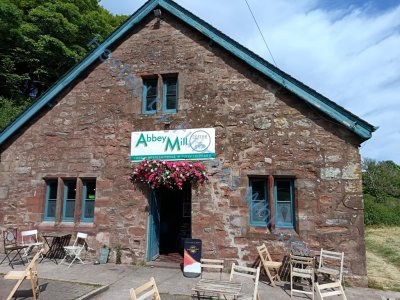
Touching the cool, weathered stone, the arch feels timeless. The smoothness of sandstone, the rustle of wind, and the view framed through it all hint at the many lives the Abbey and its surroundings have lived. Whether decorative or reclaimed, it adds an extra layer of quiet mystery to the landscape.
Walking into the Building: A Cross Above the Doorway
As you enter the Abbey Mill Cafe, take a moment to turn around and look above the doorway. There, scratched into the stone, is a simple cross — resembling a mason’s mark, yet clearly not one.
Its origin is unknown. It could be a spiritual symbol, a mark of protection, or simply a quiet mystery lost to time. In the filtered light from the doorway, the cross casts a faint shadow across the stone floor. It’s one of those subtle details that lingers with you, adding a sense of awe and reverence to your visit.
Rebirth as the Abbey Mill Cafe
Following the fire and restoration, the building reopened as the Abbey Mill Cafe. Today, it is a thriving local business nestled among woodlands, fields, and the Abbey ruins.
In winter, it becomes a cosy refuge — the aroma of hot chocolate and fresh cakes offering warmth after a visit to the sledging hill nearby. In summer, the garden is in full bloom. The sound of bees in the flowers and the feel of the sun on stone make it the perfect spot to enjoy an iced latte or a toasted sandwich.
A Place to Enjoy History and Nature
This café is not just a place to eat and drink — it’s a place where history and nature meet. The ruins of Furness Abbey, visible from the garden, create a backdrop of quiet grandeur. The scent of grass after rain, the calls of birds, and the warmth of sunlit stone all contribute to an experience that feels both grounded and timeless.
Sit outside, let the breeze move through the long grass, and allow yourself to be immersed in centuries of peaceful continuity.
A Living History: Jackie Baxter and Her Team at Abbey Mill Cafe
The Abbey Mill Cafe is proudly owned and run by Jackie Baxter, whose dedication and love for the space shines through in every detail. Jackie and her hardworking team are always on hand, offering warm welcomes, comforting food, and thoughtful service that truly makes your day that little bit more special.
Their care and effort have made the Abbey Mill Cafe more than just a place to stop — it’s a space that feels like home.
Conclusion: A Café with a Story
The Abbey Mill Cafe is not just a café. It is a living part of Furness Abbey’s legacy — a building that has withstood centuries of change, tragedy, and renewal. From its possible medieval role to its years as a custodian’s cottage, through fire and restoration, and now into its life as a peaceful retreat, it continues to serve.
Next time you visit, take a moment to pause. Look up at the old cruck frame. Step into the garden and pass under the arch. Run your hand along the stone walls. Thank Jackie and her team, and enjoy a coffee in the heart of history — where the past and present quietly meet.
100%