The mystery of Furness Abbey stained glass continues to intrigue both historians and locals. As we search for clues beyond the abbey’s ruins, we ask: could nearby churches hold surviving fragments of this medieval masterpiece? The wind whispers through the crumbling arches of Furness Abbey, and one wonders—do pieces of its stained glass live on, hidden in plain sight?
Furness Abbey’s Lost Legacy: Could Two Churches Hold the Key? part 1
8 December 2024
Local Historian Gill Jepson Suggests a Wider Search
Could Bowness Hold Furness Abbey Stained Glass?
Our investigation began with a fascinating discovery. A page from Picturesque England (published in 1891) claims that the east window of St Martin’s Church in Bowness-on-Windermere contains stained glass originally from Furness Abbey.
Picture it: vibrant hues of ruby, sapphire and emerald casting dancing patterns of light across the stone floor as sunlight streams through the intricate panels. The scene shows the noble figure of St George, beside the serene image of the Virgin Mary, bathed in celestial blue. Below, a knight stands in quiet reverence beside a mysterious figure—both identities lost to time.
#StainedGlass #ChurchHistory #Bowness
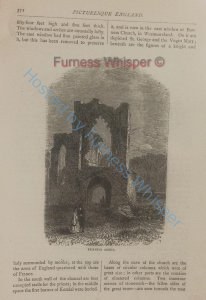
Is There Furness Abbey Glass in Great Urswick?
We were aware of the possible connection to St Martin’s, but upon showing the page to local historian Gill Jepson, she posed a new theory: could a church in Great Urswick also hold glass from the abbey?
Imagine stepping into a quiet, incense-scented church, and encountering a glowing window—its rich medieval colours still flickering in the gloom. While no definitive proof exists yet for either site, the suggestion opens up new avenues worth exploring.
#GreatUrswick #LocalHistory #HiddenGems
Why Would Furness Abbey Stained Glass Be Here?
If glass from the abbey found its way to other churches, how did it happen—especially given the abbey’s Catholic origins and the Church of England affiliation of Bowness and Great Urswick?
Here are three plausible explanations:
Preservation During the Dissolution:
Stained glass was highly valued. It may have been removed to protect it during the Dissolution of the Monasteries, when Henry VIII ordered the destruction and looting of Catholic institutions.
#TudorHistory #HistoricPreservation
Gifts from New Abbey Owners:
After the Dissolution, new owners may have gifted parts of the abbey’s treasures to local churches to curry favour with communities—despite religious differences.
#ReligiousHistory
Purchased by Wealthy Patrons:
Wealthy individuals may have acquired the stained glass and donated it to churches they supported.
#ArtHistory #Patronage
Unravelling the Mystery: Next Steps
This intriguing find, coupled with Gill’s insight, adds a compelling new chapter to the Furness Abbey stained glass mystery. Here’s how we move forward:
🔍 Examine the Windows
We’ll take a closer look at stained glass in both St Martin’s (Bowness) and churches in Great Urswick. Are there stylistic similarities to surviving Furness fragments? Can experts help analyse pigment, leadwork or technique?
#StainedGlassArt #ExploreChurches
📚 Dig into the Archives
Church records and local archives may hold overlooked mentions of window donations or renovations. Could there be receipts, inventories or references to “old abbey glass”?
#HistoricalDocuments #ChurchRecords
👥 Tap into Local Knowledge
Stories passed down through generations may provide unexpected clues. Long-time parishioners, local families and oral historians may hold pieces of the puzzle.
#OralHistory #CommunityMemory
Insights from Kay Thornton: Why a Timeline Matters
Fellow history enthusiast Kay Thornton, known for her research on Abbots Wood, offered this thoughtful suggestion:
“Create a timeline—from the founding of the churches to key events like fires or refurbishments. This will show if it was even possible for the abbey’s glass to be relocated. Also, churches with existing glass wouldn’t likely replace it—so look at side chapels or simpler windows.”
She also raised a sobering counterpoint:
“The glass may simply have been destroyed. Much was during the Dissolution. But that doesn’t mean we shouldn’t look—some might have survived.”
Her insight reminds us: history is rarely one-sided. Competing theories can coexist—and often, that’s where the magic lies.
Two Theories, One Mystery
Was the stained glass from Furness Abbey hidden and saved—or smashed and lost forever? Both perspectives offer something valuable. One is a story of survival; the other, of tragic loss. And until definitive proof appears, the truth remains tantalisingly just out of reach.
But that’s the beauty of historical mystery—it invites us to keep looking.
🔎 Join the Quest
We’re inviting everyone—local historians, stained glass experts, community elders, and curious readers—to help us solve this mystery.
Have you seen unusual stained glass in a Cumbrian church?
Do you know of a donation, a document, or even a rumour passed down?
Comment, share, or contact us directly. Let’s bring the legacy of Furness Abbey stained glass back into the light.
100%