Nestled in the heart of Dalton-in-Furness, the Dalton Carnegie Library stands as a beacon of learning and heritage. Its sturdy limestone exterior, accented with warm red sandstone, gives the building a grounded elegance. Step inside and the air smells faintly of old paper, polished wood, and the quiet hush of centuries of reading — a sensory time capsule of the town’s intellectual past.
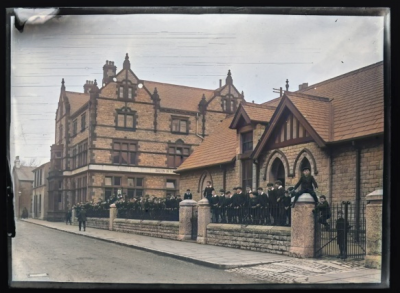
Carnegie Library and Board School
3 March 2025
The Dalton Carnegie Library: A Philanthropic Legacy
The Dalton Carnegie Library was made possible by a £2,800 grant from Andrew Carnegie in 1903. Designed by W. Richardson, the district surveyor, the building’s construction began that August and it officially opened on 30th June 1905. Local limestone gives it a cool touch to the hand, while tall arched windows flood the reading rooms with soft Cumbrian daylight.
Inside, the silence carries the rustle of turned pages, the echo of quiet footsteps on oak floors, and the distant creak of antique shelving. Once filled with community reading groups and children’s story hours, the building thrived as the town’s intellectual centre for over a century.
Though its function changed in 2016 when library services were relocated to the Drill Hall on Nelson Street, the original Dalton Carnegie Library remains a proud Grade II listed building — an architectural and cultural icon.
Education Reform and the Dalton Board School
Dalton’s commitment to education stretches beyond the library’s walls. In 1878, following the Education Act of 1870, the town opened the Dalton Board School, providing structured primary education to both boys and girls. The buildings, one on Broughton Road and another on Chapel Street, were crafted from the same local limestone, uniting Dalton’s civic architecture.
The classrooms were alive with the scent of chalk dust, coal smoke from iron stoves, and ink wells. You could hear the rhythmic ticking of classroom clocks, teachers’ footsteps across stone floors, and the collective voice of children reciting from memory.
A junior mixed school opened on Nelson Street in 1884 and transitioned into a girls’ primary in 1928. These Board Schools continued to serve the community until 1980, when they were replaced by the George Romney Junior School on Cobden Street.
Foundations of Learning: The Green School
Dalton’s earliest known school was founded in 1622 when Thomas Boulton donated £220 to establish a free school for local children. Known later as the Green School, it stood on Goose Green and offered education to twenty pupils under the care of 24 trustees.
The building, rebuilt in 1862 and again in 1869, housed generations of Dalton’s children through Victorian and post-war eras. By 1970, it had ceased its educational function and was repurposed as the Chequers Hotel, a role it held until 2019. Today, the site is being transformed into residential flats — yet the limestone walls still whisper tales of learning, discipline, and progress.
From Dalton Carnegie Library to Dowdales School
Dalton’s educational legacy continues through Dowdales School, founded in 1928 and situated on Nelson Street. Originating in the former Ashburner House — whose stone chimneys and arched entryway remain part of the campus — Dowdales now serves students aged 11 to 16.
The school’s name derives from “Peter Dowdales’ Field,” a local landmark. Its halls now echo with the modern energy of teenage footsteps, the click of keyboards, and the soft buzz of smartboard screens — a contrast to the scratching of quills that once filled Dalton’s early classrooms.
Conclusion: The Lasting Legacy of the Dalton Carnegie Library
From the sandstone pillars of the Dalton Carnegie Library to the echoing playgrounds of the Board Schools, Dalton’s dedication to education has carved itself into stone, street, and memory. The sensory journey — the scent of old wood, the warmth of sun on limestone, the sound of laughter and learning — is more than nostalgic. It’s alive.
These spaces are more than buildings. They are chapters in the story of Dalton — one still being written in every book opened, every lesson taught, and every child who passes through the schools that rose in their wake.
With thanks to Cumbria Archives for preserving the rich history of Furness, and for sharing images that help bring these stories vividly to life.
Images courtesy of Cumbria Archives.
#CumbriaArchivesPhotos
100%