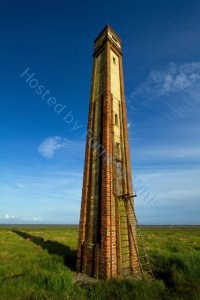
Before GPS and glowing buoys, there was the Needle Rampside —a strange, slender brick structure standing proud among the sea grass on the edge of Morecambe Bay. Painted in stripes of red and yellow, it looks more like it belongs in a packet of Skittles than on the rugged Cumbrian coast. Built in 1875, this 20-metre-tall tower, officially known as the Rampside Leading Light, is part of a still-operational range that guides vessels through the tricky Walney Channel into the port of Barrow-in-Furness.
The Needle: Rampside’s Striped Sentinel
11 June 2025
Needle Rampside and Barrow’s Industrial Boom
Back then, Barrow was booming. Shipbuilding, steel, and the railway had transformed the town from a quiet fishing village into an industrial powerhouse. The channel leading to its docks is narrow and shallow, and without accurate guidance, ships risked grounding on hidden sandbanks. To prevent disaster, a line of thirteen leading lights was installed. These worked in pairs: when a ship lined up the front and rear lights, it knew it was on a safe path. Simple, elegant, and essential.
The Surviving Needle Rampside Today
Today, only the Needle Rampside survives from that original group.
It still performs its job as the rear light in the Rampside Leading Lights range, standing watch from its soft bed of coastal sea grass and tidal marsh. The structure is made of red and yellow brick, its surface now weathered by time, salt air, and sea spray. The brickwork is coarse under the hand, patched with lichen, and streaked faintly where iron has rusted and rain has run. An old iron ladder rises partway up one face—corroded, rigid, and no longer in use.
Architecture and Features of Needle Rampside
There’s a door near the base, sealed tight. Weather-worn, metal-rimmed, and firmly locked. No one goes inside, but that only adds to its mystery.
Its form is simple but bold: a square obelisk tapering gently as it rises. Though there’s no lantern room or rotating light at the top, it still plays its part in navigation during daylight hours. It remains an active daymark, still guiding ships into Barrow with quiet reliability.
The Mystery and Legacy of Needle Rampside
Seen up close, the Needle Rampside feels both grounded and otherworldly. At low tide, the mudflats stretch around it in rippling grey sheets. At high tide, the sea laps near its base. The air smells of brine and wet grass, and gulls wheel overhead, calling out across the marsh. It doesn’t beam or flash, but it commands the landscape just the same.
And then there are the rumours. Online whispers suggest people have been inside. Others claim it once offered views from the top. Some believe old council records or forgotten maritime plans might still hold secrets. But the truth is simpler, and stranger: it’s still doing its job. Not a ruin. Not a relic. Just a quiet part of a living system — still pointing ships in the right direction.
What Is the Needle?
So what is the Needle Rampside?
Not a lighthouse. Not abandoned. Not forgotten. Just a working piece of Victorian engineering, still holding the line.
🧭 Explore the 3D Model
You can explore The Needle in 3D via Sketchfab here (standard definition):
🔗https://skfb.ly/pHSEt
100%