Walk across Biggar Bank today and there is little to suggest that a First World War tank once stood there, raised on a mound of stone and looking out across the Irish Sea.
Barrow’s Lost Tank: Why It Came to Biggar Bank and Why We Lost It
22 August 2026
Just over a century ago, the scene was very different. Families made their way across to Walney for a day away from the crowded streets and heavy industry of Barrow. Trams rattled towards Biggar Bank, children headed for the open ground and beach, and voices carried across the bank above the sound of the sea.
Then, rising above it all, was something nobody visiting Biggar Bank today would expect to find.
A First World War tank.
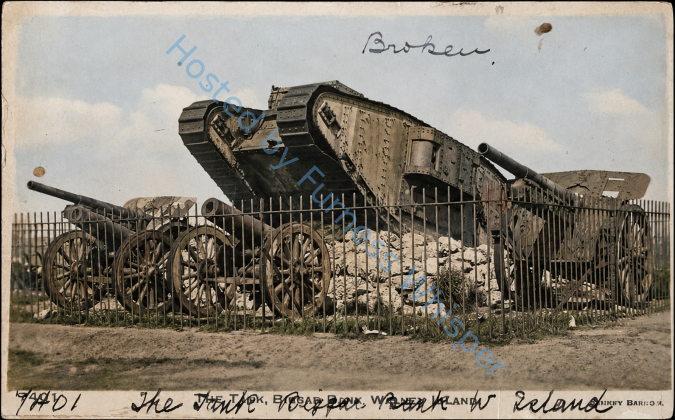
Its enormous tracks wrapped around the angular body, thick armour plates were held together by rows of rivets, and the whole machine rested heavily upon a mound of stone. Against the open landscape of Walney, it must have been an extraordinary sight.
But the tank had not simply been abandoned there when the First World War ended.
Barrow had been given it.
Why Barrow Got the Tank
When Britain entered the First World War in August 1914, Barrow-in-Furness was already one of the country’s great centres of shipbuilding and heavy engineering.
Vickers dominated much of the town’s working life. Inside the shipyard, submarines and warships took shape beside the docks while the engineering works produced guns, ammunition and other equipment needed by Britain’s armed forces.
When war came, the pressure increased enormously.
Thousands of workers passed through the gates. Machinery thundered through workshops, steel rang beneath tools and cranes moved above the shipyard as new vessels slowly grew upon the slips.
During the First World War, the Barrow yard produced more than sixty vessels, including forty-eight submarines, six cruisers, two battleships and two refuelling tankers.
For the people of Barrow, the war was not something happening only on distant battlefields. Its demands could be seen and heard throughout the town every working day.
But ships, submarines and weapons were only part of what Britain needed.
War cost an enormous amount of money.
Across the country, ordinary people were encouraged to invest their savings in War Savings Certificates and War Bonds. In simple terms, people were lending their money to the Government to help Britain continue fighting.
The Government soon found a dramatic way of attracting attention to the campaign.
It used tanks.
These machines were still something astonishing to most people. Britain had first used tanks in battle in 1916, and within a short time their strange shape and enormous tracks had become one of the best-known images of the war.
Several tanks were sent around Britain as travelling Tank Banks. Wherever they appeared, crowds gathered to see them while people were encouraged to put their money into the national savings campaign.
After the war ended, the Government decided that hundreds of surplus tanks would be presented to towns and cities in recognition of the money raised by their communities.
Barrow was one of those towns.
This is an important part of the story.
Barrow did not receive the tank simply because Vickers was building submarines, warships and armaments, although the town’s industrial contribution to the war had been enormous.
The presentation tank was connected specifically with the war savings campaign.
Ordinary people in Barrow had put their own money towards Britain’s war effort, and the tank was presented to the town in recognition of that contribution.
Barrow now had a First World War tank of its own.
The question was where to put it.
Why Biggar Bank?
Today, if a town was given an historic tank, we would probably expect to find it outside a museum or protected behind barriers.
Biggar Bank was chosen for a much simpler reason.
People went there.
By the time the tank arrived, Biggar Bank was already one of the area’s best-known recreation grounds. The opening of Jubilee Bridge in 1908 had made Walney much easier to reach, and from 1911 electric trams carried passengers out towards Biggar Bank.
For families living among the heavy industry of Barrow, it offered somewhere very different.
They could leave the streets and works behind, cross to Walney and spend time in the open air. Children could play, families could walk along the shore and people could gather around the recreation ground and pavilion.
On a busy day, Biggar Bank could be full of life.
That made it an ideal home for a gift intended for the people of Barrow.
The tank was positioned at the north end of Biggar Bank and raised on a mound of large stones, facing west towards the sea.
It could hardly have been hidden.
Imagine arriving there around 1920.
The tram reaches Biggar Bank and families begin making their way towards the open ground. Children run ahead, coats move in the wind and the sea stretches away beyond the shore.
Then ahead of you sits this enormous machine.
A tank built for the First World War, now sitting on Walney Island.
People could walk right up to it. They could see the enormous tracks, the riveted armour and the sheer size of a machine that only a few years earlier had belonged on a battlefield.
And that is something worth remembering.
The First World War was not yet distant history.
For many of the adults standing beside the tank, it was something they had personally lived through.
Some of the men visiting Biggar Bank may have served overseas. Others had spent the war working inside Vickers, building submarines and warships or producing equipment needed by the armed forces.
Families across Barrow had lost sons, husbands, fathers and brothers.
When the tank first appeared, it was not an old curiosity.
It belonged to their generation.
As the years passed, however, its meaning slowly changed.
Children grew up seeing the tank on Biggar Bank. Families returned year after year. What must originally have been an extraordinary sight gradually became part of the familiar landscape of Walney.
For around two decades it remained there.
Then another war began.
Why We Lost It
In September 1939, Britain entered the Second World War.
Once again, Barrow became crucial to the country’s naval war effort.
The shipyard was needed for submarines and warships, and thousands of people in the town once again found their working lives shaped by the demands of war.
This time the old tank on Biggar Bank had a very different value.
It was made from tons of metal.
As the Second World War continued, scrap metal became important. Across Britain, old machinery and other unwanted metal objects were collected for the war effort.
The First World War tank on Biggar Bank was taken away and scrapped.
After roughly twenty years overlooking the Walney shore, it disappeared.
There is something remarkably fitting, and rather sad, about what happened to it.
The First World War had brought the tank to Barrow.
The Second World War took it away.
The people of Barrow had originally been given the machine in recognition of the money they had contributed towards one war. Barely a generation later, the country was fighting again, and the tank itself became material that could be put back into the national effort.
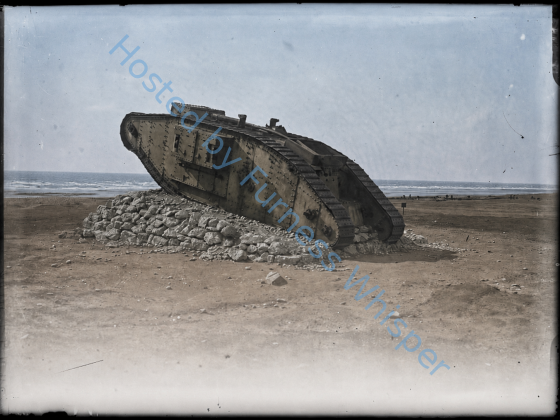
Today, it is difficult not to wonder what we would have had if it had survived.
An original First World War tank still standing on Biggar Bank would now be an extraordinary piece of Furness history. It would tell the story of Barrow’s wartime shipyard, the people who put their savings into the national campaign, the families who visited Biggar Bank and the two world wars that shaped the first half of the twentieth century.
But people living through the Second World War were not thinking about what might be preserved for visitors eighty years later.
Britain was at war.
Barrow was once again working for the Royal Navy.
Metal was needed.
And the tank went.
One War Gave It to Barrow. Another Took It Away.
That is what makes the story of the Biggar Bank tank so much more than an old photograph of an unusual object.
Barrow received it because its people had contributed to Britain’s national war savings campaign during the First World War.
It was placed on Biggar Bank because this was somewhere those people gathered, somewhere families visited and somewhere the tank could be seen rather than hidden away.
Then, when Britain found itself fighting another world war, the old machine was taken away for scrap.
Walk across Biggar Bank now and the tank has been gone for more than eighty years.
The trams have gone too, and the Walney of the early 1920s has changed beyond recognition.
But the photographs have kept one small part of it alive.
They allow us to look back to a time when families arriving at Biggar Bank were greeted by the unmistakable shape of a First World War tank sitting high above the shore.
A machine given to Barrow because of the efforts of its people.
Placed where those people could see it.
And eventually lost when their country needed its metal for war once again.
A special thank you to Cumbria Archives for kindly allowing me to use these photographs. Having the original images helps bring the story of Barrow’s lost tank back to life and allows us to see a remarkable piece of local history that has long since disappeared from Biggar Bank.
Sankey Family Photograph Collection — Image No. 7342
Sankey Family Photograph Collection — Image No. 7401
Images reproduced with the kind permission of Cumbria Archives.
100%